



|

Posted On July 10th, 2010 By Celebrity Biographies
 Nelson Mandela Nelson Mandela is one of the most popular names in the world. He served as the South African president from 1994 to 1999. Before his act as a president, he led the armed wing of ANC (African National Congress) called the Umkhonto We Sizwe. Being arrested in 1962, he spent 27 years in prison (most of them on Robben Island), serving charges of sabotage. After his release on February 11, 1990, Nelson Mandela involved himself into negotiations, finally leading to multi-racial democracy in the year 1994. He is also referred to as ‘Madiba’ in South Africa, which is an honorary title given to him by the other elderly members of his claim. During the span of four decades, he received more than 250 awards, including the Nobel Peace Prize in 1993.
Early Life
Nelson Rolihlahla Mandela was born on 18th July, 1918. He was born in a small village called Mvezo, located in the province of Umtata. Gadla Henry Mphakanyiswa, Mandela’s father was the chief of this town and as soon as he protested against the colonial authorities, the chief was deprived of his rights and the family was forced to migrate to Qunu.
Nelson Mandela’s father had four wives with a total of thirteen children, nine girls and four boys. Nelson was a child of his father’s third wife called Nosekeni Fanny. His middle name ‘Rolihlahla’ meant ‘pulling a branch of a tree’, but in this context it meant ‘troublemaker’. Mandela became the first and the only member of the family to attend school and his teacher ‘Miss Mdingane’ gave him his English name ‘Nelson’. At the age of 9, Mandela lost his father due to tuberculosis. Thereafter, regent Jongintaba took care of him as a guardian.
Nelson attended the Wesleyan Mission School, which was located next to the regent’s palace. According to the Thembu custom, he attended the Clarkebury Boarding School at the age of 16. Instead of the usual three years, Mandela completed his Junior Certificate in two years. At the age of 19, he was highly interested in running and boxing at school. He later enrolled himself at the Fort Hare University for a Bachelor of Arts program. During this course, he met his lifelong friend Oliver Tambo. By the end of first year in college, he was actively involved with the Student’s Representative Council. After consistent boycott against the university policies, he was asked to leave the university and he could return only if he agreed to accept the conditions of the university. During his term at the prison, he took an external program in Bachelor of Laws from the University of London.
On his return from the Fort Hare University, the regent arranged his marriage and in protest to the arrangement, he relocated to Johannesburg. As soon as he reached Johannesburg, he was employed as a guard at the local mine. He then worked at the Witkin, Sidelsky and Edelman law firm in Johannesburg.
Political Career
Nelson Mandela actively involved himself into politics after the Afrikaner-dominated party won the elections in 1948. He fought for the anti-apartheid causes and led the Defiance campaign of ANC in 1952 as well as the Congress of People in 1955. During these years, Nelson Mandela along with his lawyer Oliver Tambo started a law firm that provided free counsel to loads of blacks who lacked lawyer representation. Nelson Mandela was greatly influenced by Mahatma Gandhi’s approach towards truth and non-violence. He also attended the 100th anniversary of Mahatma Gandhi at a conference in New Delhi in the year 2007.
Mandela became the leader of the ANC wing in the year 1961. He became the coordinator for the sabotage campaigns against government and military targets. He also made plans for a guerrilla war in case if the sabotage failed. ANC members as well as Mandela were barred an entry from United States until July 2008. They required a special waiver from the Secretary of State in US since they were designated as terrorists due to their apartheid regime.
On June 12, 1964, Mandela was sentenced to imprisonment for life. He was imprisoned at the Robben Island, where he spent 18 years out of his total 27 years in prison. While in prison, he gained a lot of reputation as an important leader in South Africa. The prisoners were separated by race and the blacks received the fewest privileges. He was transferred to Pollsmoor Prison in March 1982. President Botha offered freedom to Nelson Mandela in February 1985 on the condition that he and his party members must give up armed struggle.
Marriage and Family
Nelson Mandela has been married three times and he has fathered a total of six children. He has 20 grand-children and an increasing number of great grand kids. All of his children were educated in the United World College. He was first married to Evelyn Ntoko Mase and their marriage lasted for 13 years, before they decided to break up in 1957. His second marriage was to Winnie Madikizela-Mandela, who happened to the first black worker in Johannesburg. The marriage ended due to separation in 1992. Thereafter, he remarried to Graça Machel née Simbine on his 80th birthday. Mandela still stays at Qunu with his royal nephew.
Nelson Mandela was elected as the oldest president of South Africa and he resumed work at the age of 75 in the year 1994. He refused to stand for the second term and took retirement in 1999. He was then succeeded by Thabo Mbeki.
Posted On July 1st, 2010 By Celebrity Biographies
 Genghis Khan In about less than a century, Genghis Khan and his followers built the largest kingdom in the world. This empire was later exceeded by the British in the late 19th century. Through brute force, spiritual mission and cunning diplomacy, Genghis Khan united the irreconcilable Mongols and then began his journey to the east and west of Asia, conquering major regions of Asia. By 1280 AD, the Mongol empire stretched from the Yellow Sea in China to the Mediterranean Sea, covering a total of 12 million miles.
Early Life
Genghis Khan was originally called ‘Temüjin’ and was born in 1162. Due to the lack of modern-day records, there is very little information on the early life of Genghis Khan. He was born in a Mongol Tribe near Kherlen and Onon River, besides the Burkhan Khaldun Mountain, located in the contemporary Mongolia. According to the history of Mongols, it is believed that young Temüjin had a blood clot grasped in his hand, which is considered as a traditional sign that he was born to become a leader. The name suggests that he may perhaps have descended from a blacksmith family. His father’s name was ‘Yesükhei’ and his mother’s name was ‘Hoelun’. His father was a chieftain of the ‘Borjigin’ clan and therefore Genghis belonged to a noble background. Since he belonged to a higher social status, it made it easier for him to solicit help from the other Mongol tribes and consolidate them.
There are no accurate portraits of this Mongol leader; however the legendary ancestors suggest that he was tall, red-haired, green-eyed and long-bearded. At the age of nine, Temüjin was taken to another tribe by his father, so as to find him a wife. While returning, Yesugei (Temüjin’s father) was killed by the Tatars. Young Temüjin and his family were abandoned by his father’s followers. They were forced to live in difficult conditions where they survived by fishing and hunting. For the next few years, the family lived in poverty. During one of the hunting excursions, at the age of 13, Temüjin eliminated his half-brother called Bekhter over a fight. After this incident, Temüjin was considered as the head of the family. His mother gave him several important lessons about the existing political conditions in Mongolia and the need for alliance.
Personal Life & Children
As arranged by his deceased father, at the age of 16, Temüjin married a young woman called ‘Borte’ of the ‘Olkut’ hun tribe. This led to an alliance between the two tribes and Borte had four sons out of this marriage. Ghenghis Khan is known to have many more children from his other wives, but none of them were included in his succession. There are no existing records of any daughters. His religion is widely considered to be Tengriism or Shamanism that is usually followed by the nomad tribes of Asia. He was known to be religiously tolerant and took moral or philosophical lessons from other religions as well. During his conquer; he often consulted Muslim merchants, Christian monasteries as well as a Taoist monk called Qui Chuji.
Rise to Power
Temüjin started attracting followers who appreciated him during battles. He became a follower of a Christian tribe chieftain called Toghril in Central Mongolia. Along with Toghril and a young chief called Jamuka, Temüjin was able to rescue his wife. Soon after his wedding, his wife Borte was kidnapped by the Merkits, a prominent tribe in Russia (this tribe is existent until today). Quite a few Mongol princes considered Temüjin as their ruler and then presented him with the title ‘Cheengiz Khan’ (Genghis Khan) which meant ‘the sole ruler of the ocean’. Toghril and Genghis Khan helped North China in their batter against Tatars and emerged successful.
Soon relations between Toghril and Genghis Khan became worse, which led to the open war between them. After being defeated in their first battle, Genghis Khan took abode in some remote areas of northeast Mongolia. 1n, 1203, he fought another battle with Toghril and defeated him. Thereafter, Toghril was killed by the Naimans and his tribe was united with the Mongols. Genghis Khan started his journey in West Mongolia, along with his associates, defeated his enemies including Jamuka, the Naimans and the Merkits in 1204. All the tribes were merged together and Genghis Khan was proclaimed as the supreme ruler.
Invasion of China & Afghanistan
Along with invading and conquering, Genghis Khan did more than that. He established some rules for his empire as well as introduced a written language for his people. He set up a basic postal service, so as to communicate with the different parts of his empire. Above all, he was a great military leader. In the year 1211, the Mongols assaulted China and invaded the north region of the ‘Great Wall’.
Thereafter, he started his hunt for Sultan Muhammad of Khiva. The Sultan possessed major parts of Central Asia, along with Afghanistan and major portions of Persia. It was a matter of time before the two empires clashed against each other. The Sultan fled across Persia and was killed near the Caspian Sea. By 1220, he expanded his empire across the west by defeating the Sultan of Afghanistan. After concluding his campaign in the west, he returned back to Mongolia. Around 1226, Genghis Khan resumed war against the Tibetan tribe called Tanguts. He died on 25th August 1227, in the Liupan Mountains of Kansu, while the war was still in progress.
Death
Genghis Khan wanted to be buried without any markings, following the traditions of his tribe. After his death, his body was returned to his birthplace in Mongolia. Many suspect that he is buried close to the Onon River. The Genghis Khan Mausoleum was created years after his death and is not his burial site. If we were to believe the folklore, it is said that the river was diverted on his grave so that it becomes impossible to locate his burial site. Some stories also suggest that his grave was stamped by several horses and numerous trees were planted over it. According to the Mongol tradition, the youngest son would inherit the father’s property and hence his army was divided accordingly.
Posted On March 15th, 2010 By Celebrity Biographies
“Old friends pass away, new friends appear. It is just like the days. An old day passes, a new day arrives. The important thing is to make it meaningful: a meaningful friend – or a meaningful day – Dalai Lama”
 Dalai Lama His holiness Dalai Lama, also known as Tenzin Gyatso, happens to be the 14th head of the state as well as the spiritual leader of Tibet. He was born to a family of farmers on July 6th, 1935, in a small village situated in north-eastern part of Tibet: Taktset, Amdo. He was named Lhamo Dhondup and by the age of two, he was believed to be the reincarnation of Thubten Gyatso, Dalai Lama the 13th. The Dalai Lamas are the patron saints of Tibet, known to be the manifestations of Chenrezig or Avalokiteshvara.
Education
His holiness Dalai Lama initiated his ascetic education when he was six years old. His course structure included five minor and five major subjects. The major subjects included Tibetan art & culture, logic, medicine, Sanskrit and Buddhist ideology. The Buddhist philosophy was later divided into five different categories such as Prajnaparimita, Madhyamika, Vinaya, Abidharma and Pramana. He chose the five minor categories as astrology, music and drama, poetry, synonyms and phrasing. He appeared for his concluding examination at the age of 23 during the annual prayer festival of 1959 in the Jokhang Temple in Lhasa. He passed the examination with honours and was also awarded the highest level degree (Geshe Lharampa). Such a degree is equivalent to the doctorate of Buddhist ideology.
Leadership Responsibilities
His holiness, Dalai Lama was invited to grant complete political power in the year 1950, after China invaded Tibet in 1949. He later went to Beijing in 1954 and conducted peace talks with Chinese leaders such as Mao Zedong, Chou Enlai and Deng Xiaoping. However, in the year 1959, with the brutal revolt against the Tibet national uprising by the Chinese troops in Lhasa, Dalai Lama was required to exile. He then escaped to Dharamsala in Northern India, which is also the place for Tibetan administration in exile. Ever since the invasion of China, Dalai Lama has requested to the UN (United Nations) committee about the condition of Tibet.
Democratization Process
In the year 1963, Dalai Lama was given a draft of the democratic constitution of Tibet, which led to a number of reforms so as to democratise the administrative set-up. He issued some important guidelines in 1992, for the future constitution of free Tibet. He proclaimed that when Tibet would become free, it would require an interim government who would then elect the constitutional assembly to strategise the democratic constitution of Tibet. His holiness would then transfer all of his chronological and political authorities to the provisional President and continue to live his life as an ordinary man. According to him, he wanted all the three provinces of Tibet (Amdo, U-Tsang and Kham) to be democratic. The reforms formed by Dalai Lama, saw its realisation in May 1990. Another major step in democratisation was taken in September 2001, when the Tibetan electorate directly appointed the most senior minister of the cabinet, Kalon Tripa. He was the first minister to elect his own cabinet that had to be approved by the Tibetan Assembly. This was the first time in the history of Tibet that the masses appointed the leaders.
Peace Initiatives
His Holiness planned the “Five Point Peace Prize” in September 1987, which was considered to be the first step towards improving the worsening conditions in Tibet. He often spoke of his vision of Tibet, which involved the country to become a sanctuary. Dalai Lama worked towards making the country, a region of peace where all beings can survive in harmony and preserve the environment. So far, China has failed to respond to several peace proposals brought into existence by His Holiness. The “Five Year Peace Plan” comprised of the basic components such as bringing about peace in the country, abandoning the population transfer policy of China, respecting the fundamental and democratic rights of the Tibetans, protecting the natural environment of the country and abandoning the use of nuclear weapons and nuclear waste from China.
The Strasbourg Proposal
During his address to the European Parliament members on June 15, 1988 in Strasbourg, he elaborated on the peace plan. He proposed peace talks between Tibet and China, leading to democratic government entity for all the provinces of Tibet. Such an entity would be in association with the Chinese Government and would continue to be responsible for the foreign policy and defense of China.
Global Recognition
Dalai Lama is known to be the man of peace. In the year 1989, he was given the Nobel Prize for Peace to recognise his non-violent effort for the liberty and freedom of Tibet. He consistently propagated policies of truth and non-violence, while facing extreme aggression. He was one of the first Nobel Laureates identified for this concern over environmental problems all across the globe.
Dalai Lama has traveled across 62 countries, stretched across 6 continents. He has had meetings with rulers, prime ministers and presidents of prominent nations. He has also held conferences with different spiritual leaders and renowned scientists. Ever since 1959, he was won more than 84 awards, prizes and honorary doctorates for his efforts on peace, inter-religious tolerances, compassion as well as universal responsibility. He has authored 72 books so far and yet he addresses himself as a mere Buddhist monk.
Posted On November 30th, 2009 By Celebrity Biographies
 Barack Hussein Obama Barack Obama was born as ‘Barack Hussein Obama’ on August 4, 1961. He is currently serving as the 44th president of United States. He is the first president to be born in Hawaii, including being the first from the African-American origin. His father Barack Obama, Sr. belonged to the Luo ethnicity of Kenya and his mother, Stanley Ann Durham belonged to Wichita, Kansas. Barack was commonly called ‘Barry’ throughout his childhood and ‘Hussein’ is the middle name since his father adopted Islam, but they were originally Christians.
Early Life
His parents met each other during college at the University of Hawaii at Manoa, where his father studied as a foreign student. His parents separated when Barack Obama was two years old and later divorced in 1964. His mother then brought him to stay with her at her parent’s house in Manoa district. In the meantime, his father graduated with a ‘Masters in Economics’ degree from the Harvard University and went back to Kenya. Barack has five half brothers and two half-sisters from his father’s other marriage. His father later became the ‘finance minister’ of Kenya and died in the year 1982 out of a car accident. Obama met his father only once before his death in 1971. On the other hand, Obama’s mother got married to another Indonesian student from the Hawaii University called Lolo Soetoro. His mother then took him to Jakarta, Indonesia along with his step-father in the year 1967.
Education
During his stay in Indonesia he attended all local Indonesian schools and soon after, he moved with his grandparents in Honolulu, Hawaii. Obama has admitted that he had a struggling childhood trying to find out answers about his multi racial and multicultural heritage. He used to find it complex to recognize such enormous differences between the skin colours of his father and his mother. He has also admitted of using marijuana, cocaine and alcohol during his teenage years.
Barack moved to Los Angeles after high school and studied for two years at the Occidental College. He then moved on to the Columbia College in New York where he majored in Political Science in 1983 along with a speciality in International relations. After spending four years in New York, Obama moved to Chicago and started working at the Business International Corporation with the NYPIRG (New York Public Interest Research Group). He also worked as a Community organizer for a church based community organization called the ‘Developing Communities Project’. He worked as a director of this organisation for four years from 1985 to 1988. This is exactly where he got his organisational skills from and later travelled to Europe and Kenya for the first time.
The Law
He entered Harvard Law School in late 1988 because he felt that law was a medium that could facilitate community organization and activism. In 1990, which is his second year at college, he was chosen to be the editor of the Law Review. He worked as a training associate at ‘Sidley and Austin’ law firm while still in law school in 1989. This is where he met his wife Michelle Robinson, who was also a lawyer in that firm. He later worked at ‘Hopkins and Sutter’ in the year 1990 and then graduated from Harvard in 1991. He moved back to Illinois, Chicago and worked a civil rights lawyer. He was offered to write a book on racial relations by the University of Chicago and was also offered a fellowship from the university. Obama got married in the year 1992 and his mother Ann died of ovarian and uterine cancer in 1994. The book was published in the year 1995 with a name ‘Dreams from My Father: A Story of Race and Inheritance’ and ended up winning the Grammy for the audio version of this book. He occasionally taught Constitutional Law at the university and was a lecturer from 1992 to 1996; however he was a senior lecturer at the university until 2004. He was also on the board of directors for several organisations such as ‘Chicago Lawyer’s Committee’, ‘Chicago Annenberg Challenge’, ‘Woods Fund of Chicago’, ‘Lugenia Burns Hope Centre’ and ‘The Centre of Neighbourhood Technology’.
Personal Life
Barack Obama and Michelle Obama had their first daughter in 1998 named ‘Malia Ann’ and second daughter ‘Sasha’ in 2001. He published his second book called the ‘Audacity of Hope: Thoughts on Reclaiming the American Dream’ in October 2006 and also won the Grammy for the audio version of this book. He is a talented writer and a dedicated basketball player. He is a major supporter of Chicago Bears and Chicago White Sox. Although he was raised in Islamic faith, Obama is an atheist by choice and his current family follows Christianity.
The Journey
He had organized largest voter registration drives in the 1992 election under the ‘Project Vote’. His work in this project led him to run for the Illinois State Senate and he was finally elected in November, 1996. With the U.S. senator Paul Simon, Obama passed the toughest campaign finance law in 1998. From the year 1997 to 2004, he went on to serve three terms in the Illinois State Senate. He lost to Bobby Rush in the year 2000, which was a primary run for U.S. House of Representatives. , he passed legislation to expand healthcare in the year 2003 to cover 70,000 children and extended health insurance to uninsured parents. Barack Obama created Illinois Earned Income tax credit that offered tax relief and also worked on several other legislation.
He came into national limelight on July 2004, with a motivational speech at the Democratic National Convention, where he openly condemned the administration policies of Bush on the Iraq War. His vocational skills are often compared to that of John F. Kennedy and Martin Luther. He started thinking about running for U.S. Senate by middle of 2002 and later announced his candidacy in the year 2003. He won the election on 2nd November, 2004 and finally made it to the US Senate. He became the fifth African American senator in the history of United States and resigned from the Illinois State Senate. Obama held minority appointments till 2006 and took major assignments in 2007. He personally visited Iraq to witness the war and introduced a legislation to end the war in 2007. He sponsored a total of 136 bills in the Senate, out of which two of them have been officially announced as laws in the US Government.
Barack Obama declared his candidacy for the ‘Democratic Presidential’ nomination in February 2007 and out of all the candidates that had filed their nominations, the only two left were Barack Obama and Senator Hilary Clinton. Obama became the presumptive nominee on the 3rd of June 2008. Obama accepted the nomination in August 2008 against the republican nominee, John McCain. Thousands of supporters witnessed the historic win on November 4th, 2008.
Posted On November 15th, 2009 By Celebrity Biographies
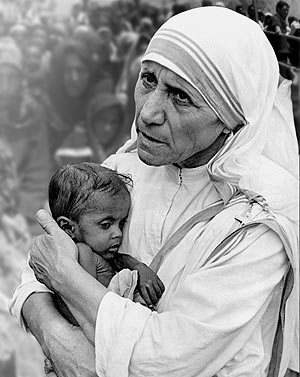 Mother Teresa Mother Teresa was born as Agnes Gonxha Bojaxhiu on August 27, 1910 in Skopje, Macedonia. Agnes was born to Nikola and Dronda Bojaxhiu and was the youngest of three children. She was actually born on the 26th of August, but she celebrated her birthday a day after, since that was the day when she was baptized. Her father was an admired merchant and was a member of the Skopje council. He was deeply involved in politics and her mother was a housewife.
Early Life
Agnes was startlingly independent, obedient and was deeply influenced by the missionary services in her childhood. Father Jambren Kovin, the pastor of her church, introduced her to the work being done by missionaries in India. She started living a religious life at the age of 18 and joined the Loreto Sisters of Dublin. She began her religious life in Ireland in the year 1928 and she learned to speak English while she was in Ireland. Later in November that year, she came to India to teach English in Calcutta (Now known as Kolkatta). She spent time as a teacher and a principle at the St. Mary’s high school in Calcutta. Agnes started her novitiate in an Abbey in Darjeeling in 1929 followed by the Abbey in the foothills of the Himalayas.
Vows
This is the time that a nun spends praying, studying and contemplating prior to taking her vows. Agnes took her first vows on May 24, 1931 of chastity, poverty and obedience. This is when she took her name from the patron saint of missionaries, St. Theresa and was called Teresa. Teresa took her final vows on May 14, 1937 promising to serve God for the rest of her life. She left the convent in August 1946, when the city was in terror and surrounded by riots. Sister Teresa was granted the permission to leave the Loreto Order of Nuns in 1947; however she left on August 16, 1948. She traveled all across Calcutta wearing a white saree with a blue border, sacrificing the Loreto Abbey. She learnt medical skills from Mother Anna Dengel in Patina, before servicing the slums. With her abilities, she was included in the Medical Missionary Sisters Group. While returning to Calcutta, she stayed at the St. Joseph’s Home with the Little Sisters of the Poor. She stayed here until December 21, 1948 and then went back to the slums.
The Journey
In order to demonstrate her dedication to Calcutta’s poor she decided to become an Indian citizen in 1949. Cardinal Pietro Fumoson Biondi sanctioned Sister Teresa’s order on October 7, 1950 and this is when she was called ‘Mother Teresa’. The Missionaries of Charities shifted to a new residence in the middle of 1953. She was given an unused building for the dying in 1954 and with the help of other nuns; she transformed the place into ‘The Place of the Immaculate Heart’. During this time, she was often criticized for wasting funds on the dead and dying; however she had great compassion for the victims of leprosy. Establishing the 35 acre ‘Town of Peace’ for the lepers was one of the biggest achievements of her life. ‘Missionaries of Charity’ formed groups to travel to different parts of India in 1960. Due to loads of contributions 30 centres were released outside Calcutta. In the same year, she travelled across the states of US and visited several other countries to collect donations. She gathered numerous ideas for her institution.
The ‘Missionaries of Charity’ gained permission by the Pope to work outside India in February 1965. They established the first home in Cocorote Venezuela and by 1970; they had set up ten houses around South America that would provide food, clothing and shelter to the poor. Pope Paul Vito requested Mother Teresa to open a house in Rome in the year 1968 and she also went to Tanzania. With the help of Ann Blankie, she founded the ‘International Association of the Co-workers’ in 1969.
Awards
Mother Teresa was awarded the first Pope John XXIII Peace Prize by Pope Paul VI in the year 1971. This included a small statue of Christ and $67000 as a charity. Mother Teresa brought her work to the US in 1971. She was given the ‘Joseph P. Kennedy Foundation Award’ in October by the Kennedy family, which consisted of $12000 as a charity for disabled children. Mother Teresa was also awarded the ‘Templeton Prize’ for Progress in Religion in 1973. She received a lot of awards for her work for the poor; however the highest of all was the Nobel Peace Prize On December 9, 1979 which included the prize amount of $190,000. Three months later, she was given the biggest award in India, called the ‘Bharat Ratna’ award. President Reagan awarded her the ‘Presidential Medal of Freedom’ in 1985.
Mother Teresa was given back to God On September 5, 1997 and her body was buried on September 13, 1997. Millions of people gathered around for her funeral ceremony. After her death, the Holy See began the beatification process, which is the third step towards canonization. Such a process requires documentation of some miracle performed by the intercession of the Late Mother Teresa.
She still remains alive in the form of her work and her teachings. She was a human being who was respected and admired all around the world. Mother Teresa stands out in billions today and shall always be remembered as one of the kindest human beings of all times.
|




|










 1 Comment
 Post A Comment


